
SEO vs Google Ads in Kenya: Which Is Better for Your Business? (2026 Comparison)
A clear comparison of SEO and Google Ads for Kenyan businesses: cost, speed, control, lead quality and long-term value, with typical KES budgets, timelines and a plan for using both together.
Key takeaways
- Google Ads can bring enquiries within days but stops the moment you stop paying; Google also adds 16 percent VAT to ad charges in Kenya.
- SEO usually takes months to build but keeps bringing traffic without a cost per click once pages rank, and it feeds AI Overviews and AI assistants.
- Typical Kenyan budgets are KES 15,000 to 100,000+ a month in Google Ads spend and KES 20,000 to 100,000 a month for an SEO retainer.
- Most businesses do best with ads for immediate demand and SEO for long-term growth, using ads data to choose which keywords to target organically.
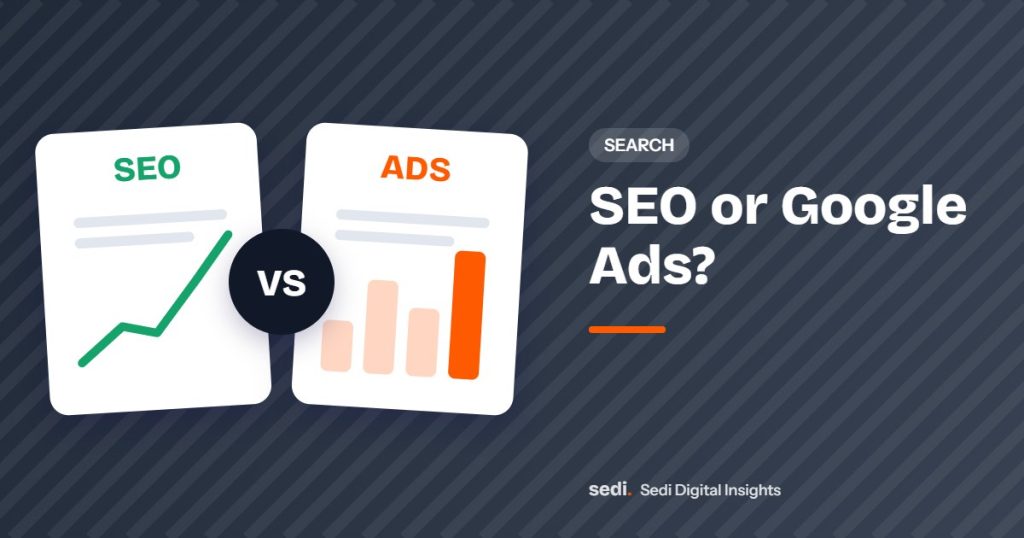
SEO and Google Ads both put your business in front of people searching on Google, but they work differently. Google Ads buys you a place at the top of the results within days and stops when you stop paying. SEO earns free organic rankings over months and keeps working after the effort is done. For most Kenyan businesses the best answer is not one or the other, but the right mix for your goals, budget and timeline.
This guide compares SEO vs Google Ads side by side, shows typical budgets in KES, explains when each makes more sense and gives you a simple plan for running both together.
SEO vs Google Ads at a glance
| Factor | Google Ads | SEO |
|---|---|---|
| Speed | Clicks and enquiries can start within days of launch | Commonly three to six months for early results, longer for competitive terms |
| Cost model | Pay per click, plus 16 percent VAT in Kenya | Investment in content, technical work and links; no cost per click |
| When you stop | Ads and traffic stop immediately | Rankings usually continue for months, then slowly decline without upkeep |
| Control | Full control of keywords, message, budget, location and timing | Less control; Google decides rankings |
| Trust | Labelled as sponsored | Organic results often earn more trust and clicks for research queries |
| AI search | Ads are separate from AI-generated answers | Well-ranked, clear pages can be cited in AI Overviews and by AI assistants |
| Measurement | Precise: cost per click, per lead and per sale | Measurable through Search Console and analytics, but slower to attribute |
| Best for | Launches, offers, urgent demand, testing | Long-term growth and a lower cost per lead over time |
How each one works
Google Ads
You choose keywords, write ads, set a daily budget and pay when someone clicks. Google may spend up to twice your average daily budget on a busy day, but your monthly charges will not exceed about 30.4 times the daily average. Since February 2023 Google has charged 16 percent VAT on ads in Kenya, so a KES 50,000 budget costs KES 58,000. Our full guide to Google Ads in Kenya covers setup, costs and campaign types.
SEO
Search engine optimisation means improving your website so Google understands it, trusts it and ranks it for relevant searches. That includes technical fixes, strong service pages, helpful content, reviews and links from other reputable sites. Google itself warns that no one can guarantee a number one ranking, so be wary of anyone who promises one. Our beginner guide to SEO and SEO guide for Kenya explain how rankings work.
Typical budgets and timelines in Kenya
| Item | Typical range | Notes |
|---|---|---|
| Google Ads spend, small local business | KES 15,000 to 30,000 a month | One town, a few high-intent keywords |
| Google Ads spend, established SME | KES 30,000 to 100,000 a month | Several services or towns |
| Google Ads management (if outsourced) | Fixed fee or a percentage of spend | Varies by agency and account size |
| SEO retainer | KES 20,000 to 100,000 a month | Depends on competition, site size, content and links |
| One-off SEO audit | KES 15,000 to 80,000 | Good first step before a retainer |
These are typical market ranges, not fixed prices. Competitive sectors such as real estate, insurance, education and betting cost more on both channels. Our SEO pricing guide for Kenya and digital marketing cost guide break the numbers down further.
A worked example: the same KES 60,000 spent two ways
Imagine a plumbing company in Nairobi with KES 60,000 a month to spend on search for a year. The numbers below are illustrative, not a forecast, but they show how the two channels behave over time.
- All on Google Ads: the phone starts ringing in the first week. If an average click costs around KES 60 and one in ten clickers calls or sends a WhatsApp message, the KES 60,000 covers about KES 51,700 of clicks once 16 percent VAT is added, buying about 860 clicks and 86 enquiries a month. Month twelve looks much like month one, and in month thirteen, with no budget, enquiries drop to zero.
- All on SEO: the first two or three months bring little, while the site is fixed and service pages are written. Visibility then tends to build as pages rank for “plumber in Kilimani”, “blocked drain repair Nairobi” and similar searches. By the second half of the year organic enquiries may match or beat what ads delivered, and they keep arriving after the work slows down.
- Split between both: ads cover the slow early months, SEO builds underneath, and the business ends the year with paid and organic enquiries plus clear data on which searches actually produce jobs.
Your real results depend on competition, your website, your reply speed and your offer, which is why testing and tracking matter more than any rule of thumb.
How AI search changes the comparison
Google’s AI Overviews and AI Mode are available in Kenya, and people also ask assistants such as ChatGPT and Gemini for recommendations. These answers draw on pages that are already well structured and trusted. That gives SEO extra value in 2026: a clear service page with prices, locations and genuine reviews can rank, appear in the map results and be cited in an AI answer. Ads still sit above or below these answers, so for urgent, high-intent searches they remain the fastest way to guarantee visibility. Read our guide on getting recommended by AI search in Kenya for the practical steps.
Which works better by industry?
| Industry | Lean towards | Why |
|---|---|---|
| Emergency services (plumbing, towing, locksmiths) | Google Ads plus Google Business Profile | Buyers need help now and call the first credible result |
| Real estate and land | Both | Ads for launches; SEO for research-heavy buyers and diaspora investors |
| Clinics and professional services | SEO and local SEO first, ads for key services | Trust and reviews drive the decision |
| Schools and colleges | Ads during admissions, SEO all year | Demand peaks around intake dates |
| Online shops | Shopping and search ads, plus SEO for categories | Product searches convert quickly; category pages compound |
When Google Ads makes more sense
- You need enquiries this month, for example a new business, a new branch or a seasonal offer.
- You are running time-limited promotions, events, admissions or product launches.
- Your keywords are highly competitive and organic rankings will take a long time.
- You want to test which services, messages and prices convert before investing in content.
- You sell to a narrow area and want to show ads only within a few kilometres of your location.
When SEO makes more sense
- You want a steady flow of enquiries without paying for every click.
- Your customers research before buying and read guides, comparisons and reviews.
- You serve specific towns where Google Maps rankings drive calls and visits.
- You want to be cited by AI Overviews and AI assistants, which draw on trusted web pages.
- You plan to be in business for years and want an asset that compounds.
The best answer for most businesses: use both
SEO and Google Ads work best as one search strategy:
- Start ads on your highest-intent keywords, such as “solar installer Nakuru” or “school fees Kiambu”, to bring enquiries while SEO builds.
- Use ads data to learn which searches and messages turn into paying customers.
- Prioritise those keywords in SEO with strong service pages, location pages and guides.
- Reduce ad spend on terms where you rank well organically, and move budget to new or competitive terms.
- Retarget organic visitors with display and YouTube ads so they come back when ready to buy.
A simple way to decide your budget split
| Your situation | Suggested starting split |
|---|---|
| New business with an urgent need for leads | About 70 percent ads, 30 percent SEO foundations |
| Established business with some rankings | Roughly 50 percent ads, 50 percent SEO |
| Strong organic presence | Mostly SEO and content, with ads for competitive terms and promotions |
Whatever the split, track every enquiry back to its source with call tracking, WhatsApp links and form tracking, then move money to what produces customers. Our digital marketing strategy guide shows how to set that up.
Do not forget the landing page
Both channels fail if visitors land on a slow, confusing page. A fast, mobile-friendly page with a clear offer, prices or price guides, reviews and a WhatsApp or call button improves results from ads and SEO at the same time. Our guide to a website that brings leads lists what to fix first.
Common mistakes
- Running Google Ads to the homepage instead of a dedicated landing page.
- Bidding on broad keywords that attract job seekers or students rather than buyers.
- Stopping SEO after two months because rankings have not moved yet.
- Buying cheap “guaranteed ranking” packages that build spammy links.
- Measuring clicks and rankings instead of enquiries and sales.
Get the right mix for your business
Sedi Digital runs SEO and AI search visibility and Google Ads management for Kenyan businesses, and plans them together so each shilling supports the other. Plan your project with Sedi Digital and we will recommend a starting split based on your market, competition and goals.
Frequently asked questions
Is SEO cheaper than Google Ads?
Over the long term, usually yes, because you do not pay for each click once pages rank. In the short term SEO is an investment with little immediate return, while Google Ads produce results quickly at a cost you control. The cheapest option overall depends on how competitive your keywords are and how long you plan to stay in business.
Should a new business in Kenya start with SEO or Google Ads?
A new business that needs customers this month should usually start with Google Ads on high-intent keywords and a complete Google Business Profile, while laying SEO foundations at the same time. As organic rankings grow, ad spend can be reduced or moved to the most profitable keywords.
Do Google Ads help SEO rankings?
No. Paying for ads does not directly improve your organic rankings. However, ads data shows which keywords, messages and landing pages turn searches into customers, which makes your SEO plan sharper and less of a guess.
How long does SEO take to work in Kenya?
Many businesses see early movement within three to six months, with stronger results over six to twelve months, depending on competition, your website's condition and how consistently you publish and earn links. Local searches with a Google Business Profile can respond faster. No one can honestly guarantee a specific ranking.
Which brings better quality leads, SEO or Google Ads?
Both can bring high-intent leads because both reach people who are actively searching. Organic results often earn more trust, while ads let you control the message, timing and landing page precisely. The quality usually depends more on keyword choice and the landing page than on the channel itself.
Keep reading
AI Marketing Tools: A Practical Guide for Kenyan Businesses (2026)
How Kenyan businesses can use AI marketing tools for content, design, video, ads, chatbots and analytics, which tools to use for each job, the risks to manage and how AI is changing search.
What Is SEO? A Simple Guide to How SEO Works (2026)
A beginner's guide to SEO for Kenyan business owners: how Google finds and ranks pages, the main types of SEO, AI search, a 30-day checklist and the free tools to use.
SEO Pricing in Kenya (2026): How Much SEO Costs and What You Get
How much SEO costs in Kenya in 2026, how agencies charge, what each package tier should include and how to judge whether SEO is paying off.